UPS Systems – Planning an IT Comms room(s)?
UPS power solutions are essential for preventing issues caused by disturbances in utility mains supply, such as data loss or equipment failures. They protect against 'brownouts' and voltage spikes that can disrupt operations. While line conditioning can mitigate some effects, they do not supply power during outages—this is where UPS systems are critical.
There are different types of UPS systems based on user needs:
- Home/Small Office: Uses a line interactive UPS to regulate power and provide battery backup during interruptions, allowing for safe data shutdowns.
- Data Centres: Require more robust parallel ‘double conversion’ UPS systems for resilience and constant power, ensuring continuous operation with redundant modules.
Beyond computers, UPS systems help with short-term power needs in emergencies, like operating fans during fires. Limitations depend on battery autonomy, which governs how long they can support equipment.
PowerContinuity offers free calculations for UPS requirements, emphasizing the importance of preparedness.
UPS power solutions are required whenever aberration of the utility mains supply will result in problems occurring. Whether it is loss of data on a server or the failure of life-support equipment. It does not have to be an interruption to the utility mains supply. High volt ‘spikes’ occurring due to the operation of other plant connected to the utility power network, can cause interruptions or failure of unprotected equipment.
What can UPS Power Solutions prevent?
Let’s begin with the most common.
‘ Brownouts’, while not a total loss of supply, they can affect the normal running of installed equipment. Causing it to malfunction due to insufficient voltage for correct operation and also possibly causing overheating. There are other forms of line conditioning. They can alleviate some of the problems caused by ‘brownouts’ and ‘spikes’. Supplying a constant voltage output to the operational equipment. What they cannot do is to provide a supply in the event of the utility mains supply failing for a period of time. Even as short as 30 milliseconds. This type of break is enough for the equipment power supplies to shut down and for the operation of the equipment to fail. So now you understand why you require Uninterruptible Power Supplies, commonly referred to as UPS Power Systems.
To overcome this problem where the equipment cannot stand a loss of supply for longer than 10 – 15 milliseconds we have the UPS Power Solution. The type of UPS Power Solutions is entirely dependent upon the load in question.
At one end of the scale we have the home/small office user, where if the computer failed due to a malfunction caused by the utility mains the operator could lose their data, possibly without the benefit of current backup being available. UPS Power Solutions for this type of operational status would be a line interactive UPS.
During normal operation, the UPS would be regulating the incoming utility mains supply. Often by a transformer tap changing circuit, against ‘spikes’ and ‘brownouts’. Should the utility mains supply deviate outside the limits set for correct regulation, the UPS would switch the output to its inverter. Running on battery until either the utility mains returns within the preset operating tolerance of the UPS or the battery falls to its lower safe operating limit. At that point, the UPS can transmit a signal to the computer telling it to carry out a controlled shutdown to prevent loss of data.
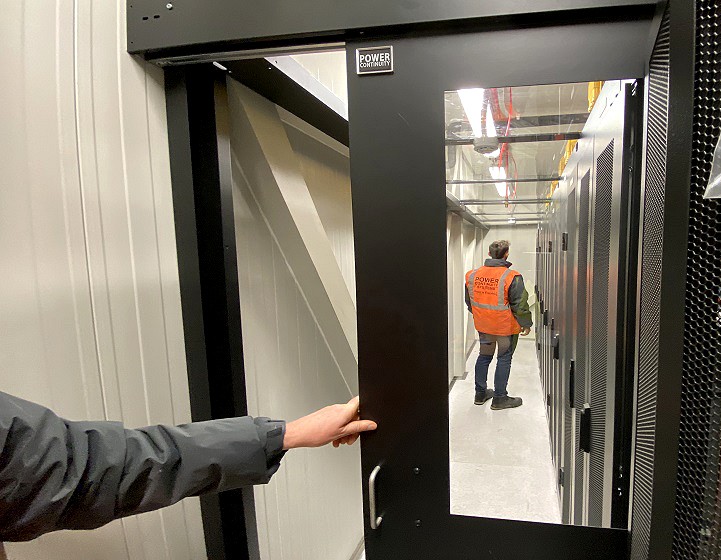
The other end of the scale would be a Data Centre where there would be multiple rows of server cabinets. The proposed UPS Power Solutions for this situation would undoubtedly be a parallel ‘double conversion’ UPS power system. The use of a ‘double conversion’ UPS system means that the inverter is on line constantly. Requiring no switching action as described previously. The use of a parallel system also provides greater resilience to loss of the utility mains supply. As the parallel system would be in an N+1 configuration. In the event of either a module failing/being t aken off-line for service- always a spare module instantaneously available.
UPS Power Solutions are not confined to supporting computer systems. Whenever there is a requirement for short-term power during a utility mains failure, the UPS Power Solution can be the preferred answer.
In some instances, the UPS power solution can be used as an emergency supply for opening or closing electrically operated doors; there is no requirement to provide uninterruptible power. Just a power source in the event of losing the utility mains supply. Equally, UPS Power Solutions would be suitable for running smoke exhaust fans within a building. In the event of fire the utility- mains supply will be turned off. Therefore, the UPS Power Solution is ideal for running fans to clear the area of smoke. The requirement is for a means of operating equipment for a finite time without the benefit of utility mains power. The UPS Power Solution on its own is an ideal method of providing temporary power in the event of a utility mains failure. Limitation is governed by the battery autonomy. It is suitable where the equipment it is supporting can be shutdown safely before the end of autonomy. Alternatively, where the requirement is for a short-term supply to operate vital equipment under controlled conditions.
Let PowerContinuity calculate your UPS Power Solutions requirement.
No cost to yourself, entirely free of charge, and get the peace of mind that only preparation can offer.