Sizing a UPS and Generator Power Protection System
When sizing UPS (Uninterruptible Power Supplies) and Diesel Generators for Power Protection Systems, it’s crucial to consider the power values and their compatibility. A UPS must ideally allow for future growth by 25% and operate below a 75% load to ensure optimal function. The power ratio for sizing Diesel Generators is commonly a 2:1 ratio compared to UPS ratings; for instance, a 100 kVA UPS requires a 200 kVA Generator. Additional factors include the battery charging capacities, run time requirements, and potential harmonic distortions, which can affect generator performance. Proper sizing is essential to handle thermal rises and ensure the generators operate efficiently. It is recommended to utilize specialized tools, such as the Power Calculator app, to assist in these calculations. Overall, the integration of UPS systems with Diesel Generators necessitates a detailed understanding of power ratings and harmonic impacts, highlighting the importance of accurate sizing.
Selection of the respective power values must be taken into account when sizing a UPS and Generator Power Protection Systems. Power Protection systems require both a UPS Power System and a Standby Diesel Generator. Working together in unison.
Let’s explain how they work with each other and what you need to know.
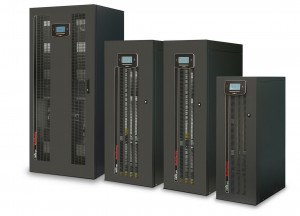
Firstly,Uninterruptible Power Supplies (UPS)
REMEMBER –
It usually takes up to 4 hours for a UPS to recover from a one-hour power loss. Scale your UPS allowing for future growth of 25% as a minimum growth factor and bearing in mind that any UPS should never run consistently with more than 75% load. Choose a UPS equipped with a built-in active filter or a PFC rectifier (drawing a sinusoidal signal) to avoid the negative effects of harmonics on a Diesel Generator and the need for the generator to be twice the size of the UPS in kVA.
To calculate these easily you can download ourPower Calculator app from the Apple App Store and the Google Play Store for FREE.
Diesel Generators (Gensets)
- The increase in the size of the Diesel Generator 2:1 (rule of thumb is 2 to 1), so for example a 100kVA UPS requires a 200kVA Diesel Generator.
- Make sure the Diesel Generator power rating can also handle battery charging at Diesel Generator start (see the example below).
- Calculate how many minutes you require the UPS battery backup to have, as well as how many hours you wish the Diesel Generator tanks to run (at least 8- 12 hours of running time).
To calculate these easily you can download our Power Calculator app from the Apple App Store or on the Google Play Store for free –Click here to download. This example presents how to calculate the Diesel Generator power rating, assuming that appropriate filtering is installed (active or PFC) and load-shedding is not an option. The rated power Pn (kVA) of a UPS is the maximum output power given an output power factor of 0.8. It’s necessary to calculate the corresponding input power to determine the Diesel Generator power rating.
For Example:-
UPS
A 100 kVA UPS supplies the load with a maximum output power factor of 100 x 0.8 = 80 kW. And surprisingly a Generator is virtually the same power factor.
GENERATOR
A 100 kVA DIESEL GENERATOR supplies the load with a maximum output power of 100 x 0.75 = 75 kW.
OTHER FACTORS TO TAKE INTO ACCOUNT when sizing UPS and Generators.
Diesel Generator Power Factor
NOTE – Diesel Generators have a power factor of around 0.75
Gas Generators have a power factor of around 0.50, LPG Generators have a power factor of around 0.45, Given UPS efficiency and the current required to charge the battery, the input power is greater than the output value. This emphasises the importance of power rating UPS and Generator Power Protection System.
For example,
if the increase is 18% (value supplied by the manufacturer), the necessary input power is Pe = 80 x 1.18 = 94.4 kW. Therefore the Diesel Generator must be sized to supply power Pg. Such that, if the input power factor is 0.8, then Pg > 94.4 / 0.8 = 118 kVA. In this case, where both the input and output power factors are equal to 0.8, it is possible to calculate the result as 100kVA x 1.18 = 118 kVA. On the other hand, if the UPS has a PFC rectifier with a power factor close to 1 (> 0.95), then Pg > 94.4 / 0.95 = 99.3 kVA.
UPS input current when charging the battery
Diesel Generator rated power must be sufficient to supply the UPS power systems.
Especially, when the rectifier-charger is both supplying the load (load current) and recharging the battery (lb current).
Importantly take these into account when sizing a UPS and Generator power protection system.
This is the situation when the Diesel Generator starts to supply the UPS, i.e. approximately 60 to 90 seconds after the beginning of the power outage.
As this point the UPS batteries maybe partially discharged or totally depleted.

WHAT ABOUT POSSIBLE HARMONICS ?
Harmonics
Possible harmonics and harmonic filter at the UPS input To supply the inverter with DC current, the UPS is equipped with an SCR-based rectifier. Drawing harmonics which distort the sinusoidal waveform of the input current (see fig. 3) and the upstream voltage.
Total Harmonic DistortionDistortion is measured as Total Harmonic Distortion (THD):
THD% = (rms value of all harmonics) / (rms value of the fundamental) in %.
Depending on whether current or voltage distortion is measured, the terms used are:
• THDI where I stands for current.
• THDU where U stands for voltage.
How to eliminate harmonic currents
To eliminate harmonic currents, UPSs are equipped with an input filter.
Consisting either of the following:
– a passive LC filter, compensated or non-compensated, with or without a contactor,
– a double-bridge or phase-shifting filter (harmonic recombination),
– an active filter, derived from active harmonic conditioners.
– especially when power sizing UPS and Generators.
Harmonic filters
These filters reduce distortion from approximately 30%) to less that 5%
• or a “clean” rectifier of the PFC (Power Factor Correction using control electronics) type that does not draw harmonics. In this case (without a filter), THDI drops to under 3%. Both solutions meet the requirements of standard IEC / EN 61000-3-4 for low-voltage devices drawing less than 16 A, i.e
• THDI < 5% at the UPS input.
• THDU = 5% on the upstream busbars.
• no individual harmonic order higher than 5%.
Behaviour of a Diesel Generator with harmonics
Diesel Generators are designed to supply linear loads. Any presence of harmonics makes it necessary to take remedial action to ensure compatibility, due to the possible repercussions on the Diesel Generator.
Harmonic Regulations
• Regulation difficulties:
The distortion increases the rms value of the output voltage and thus disturbs Diesel Generator regulation, which is based on the rms value of sinusoidal voltage. What is more, the high time constant of the flux variations in the windings makes corrections difficult.
• Temperature rise in generator winding because the harmonics increase the rms current.
• Amplification of the harmonics (1) with a number of consequences:
– increase in voltage distortion (THDU, normally limited to 5%) on the upstream busbars during operation on Diesel Generator power.
– reduction in the input power factor (< 0.8).
Harmonic sub-transient reactance
The sub-transient reactance X”d of a generator is approximately 10 to 12%, compared to 3 or 4% for the short-circuit voltage of a transformer. In other words, the output impedance of a Diesel Generator is 2 to 4 times higher than that of a transformer. Each harmonic order lHk, a sinusoidal current k times the fundamental frequency, is amplified compared to normal operation on utility power with the output impedance of the transformer.
Power rating the Diesel Generators.
Oversize the Diesel Generator.
A classic solution to avoid the effects of harmonics is to oversize the Diesel Generator. The power rating of the diesel generator is 2 times greater than that of the UPS. For example 2:1 ratio. Overall, this highlights the importance of correctly sizing a UPS and Generator Power Protection System. This increase in power makes it possible to handle the temperature rise in coils, to ensure correct regulation and to obtain a higher output impedance.
What are the possible solutions for UPS power systems?
Reduce the level of harmonics drawn by the UPS First we need to understand that the industry average of THDi is around 5%. A modern True On-Line UPS designed to reduce the level of harmonics drawn by the rectifier is built to be around 5%. Should there be any requirement to have a lower THDi then this is possible using either.
• A built-in active filter optimised for the UPS power rating and input rectifier. This type of filter eliminates a large part of the harmonic spectrum and reduces the THDI to less than 3% • PFC (Power Factor Correction) rectifier draws a sinusoidal signal. The residual THDI is less than 2%. UPS systems of less than 2% are extremely expensive. Either of these options are costly and only ever required where extremely sensitive equipment is used – military / medical.
To calculate these easily you can download our Power Calculator app from the Apple App Store or Google Play for free – Click Here to download.

If you’re looking to size a Generator or a UPS Call us on 0845 055 8455 We’re here to help!
THIS INFORMATION IS PROVIDED FREE TO USE BY POWER CONTINUITY LTD.
Power Continuity and Powercontinuity are registered trade marks