How to size a UPS ( Uninterruptible Power Supply )
To effectively size a UPS (Uninterruptible Power Supply), consider key factors such as peak load, required battery autonomy, and UPS environment (max 22C, dry, dust-free). Maintain load below 75% and ensure the floor can support the weight of the UPS. Install a bypass system and prefer established brands. For downsizing or optimal performance, aim for a PFC rectifier with a power factor near 1. Assess the input current demand of backup generators for charging, which influences recharge times (12-24 hours if batteries are depleted). Address potential harmonics with suitable filters to minimize distortion (THD). To achieve lower than 3% THD, use advanced filters. Overall, proper sizing of UPS is essential for reliable power management.
Factors to consider in calculating UPS power.
Take into account these respective power factors presented below when considering how to size a UPS:-
Uninterruptible Power Supplies (UPS)
Ensure that you know what is the peak load of all the equipment to be supported by the UPS.
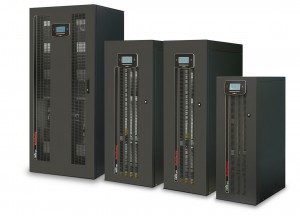
Calculate how many minutes battery autonomy you require. Remember that any UPS should never run consistently with more than 75% load. Keep the UPS environment at ambient max 22C. Furthermore the UPS location must be dry and dust free. By the same token, the more minutes of autonomy, will require a larger space for the VRLA batteries. Correspondingly, the larger the UPS power system, the heavier weight and the more batteries.
Important to check the floor loading can support the weight of the complete Uninterruptible Power Supply solution. Therefore size a UPS to fit within your room space available. Equally important, always install a UPS bypass system. Moreover, choose a well known Global UPS rather than a ‘Mickey Mouse’ house brand. PowerControl UPS by installing SNMP(Systems Network Management Protocol).
In the first place, check the UPS is equipped with a built-in active filter or a PFC rectifier.
To easily calculate the size of your UPS,
download our Power Calculator app from the Apple App Store for free – Click Here to download. On the other hand, if the UPS has a PFC rectifier with a power factor close to 1 (> 0.95), then Pg > 94.4 / 0.95 = 99.3 kVA, life is good.
UPS input current when charging the battery
This is the situation when there is A Standby Diesel Generator to supply the UPS. i.e. approximately 60 to 90 seconds after the beginning of the power outage. Diesel Generator rated emergency power must be sufficient to supply the UPS when the rectifier-charger is both supplying the load (load current) as well as recharging the batteries (lb current) when the batteries are discharged. Conversely, should the UPS batteries be completely depleted, it will take anything from 12 to 24 hours to recharge them back to 100% capacity.
Harmonics
Possible harmonics and harmonic filter at the UPS input The UPS is equipped with an SCR-based rectifier. This in turn, supplies the inverter with DC current, Drawing harmonics which distort the sinusoidal waveform of the input current and the upstream voltage.
Total Harmonic Distortion
Explain what is Total Harmonic Distortion (THD):-
THD% = (rms value of all harmonics) / (rms value of the fundamental) in %
Depending on whether current or voltage distortion is measured, the terms used are:
• THDI where I stands for current.
• THDU where U stands for voltage.
How to eliminate harmonic currents
UPS are equipped with an input filters to eliminate harmonic currents, .
Consisting either of the following:
– A passive LC filter, compensated or non-compensated, with or without a contactor.
– A double-bridge or phase-shifting filter (harmonic recombination).
– An active filter, derived from active harmonic conditioners.
Harmonic filters
These filters reduce distortion from approximately 30% to less that 3%.
A “clean” rectifier of the PFC (Power control electronics) type that does not draw harmonics.
In this case (without a filter), THDI drops to under 3%.
Both solutions meet the requirements of standard IEC / EN 61000-3-4 for low-voltage devices drawing less than 16 A, for example:-
• THDI < 3% at the UPS input.
• THDU = 5% on the upstream busbars.
• no individual harmonic order higher than 5%.
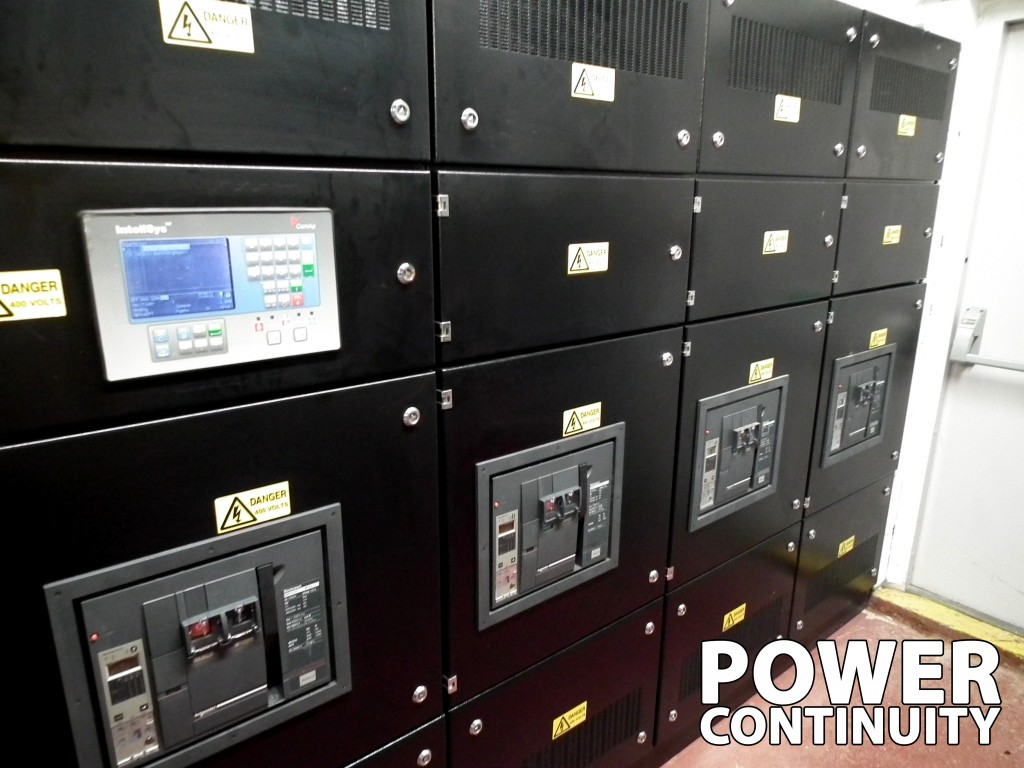
Is your UPS power system be backed up by an Emergency Power Systems?
If so,do remember the generator is to be twice the size of the UPS in kVA.
Likewise, there can be negative effects of harmonics down stream on a Diesel Generator.
Size a UPS to allow for all of the above.
Harmonic filter solutions within UPS power systems.
Reduce the level of harmonics drawn by the UPS. See above.
Firstly, understand that the industry average of THDi is around 3 to 5%.
True On-Line UPS have inbuilt rectifiers that reduce THDi to around 3%.
Of course, should the requirement be to have a lower THDi than 3%,then this is possible.
How to achieve a lower then 3% THDi UPS power systems.
To achieve a lower then 3% THDi the UPS requires:-
A built-in active filter optimised for the UPS power rating and input rectifier.
This type of filter eliminates a large part of the harmonic spectrum and reduces the THDI to less than 3%.
Power Factor Correction rectifier that draws a sinusoidal signal.
The residual THDI can be than 2%.
UPS power systems of less than 2% are rare and extremely expensive.
Not impossible, just expect a higher purchase price for such bespoke UPS power systems.
Either of these two options are costly and only ever required where extremely sensitive equipment is used – military / medical.
To calculate these easily you can download our Power Calculator app from the Apple App Store for free – Click Here to download.