Diesel Generator Load Acceptance Explained
The typical load acceptance for diesel generators is 65-70% of their maximum capacity, influenced by engine and alternator combinations. Variations may exist, but tolerances are narrow, assuming engines are warmed and regularly serviced. Improper load planning, such as adding heavy step loads suddenly, can cause issues. Proper maintenance includes regular servicing, ensuring sufficient coolant and battery conditions, and minimizing startup loads to within 65% capacity. Understanding generator types is crucial: emergency standby generators allow a brief overload, while prime power generators support varying loads for unlimited hours. The impact of step loads on generator sizing is significant; oversized generators may be necessary for high initial loads. Power factor, typically around 0.75-0.8 for diesel generators, is also critical in load calculations.
Typical load acceptance of a diesel generator depends on the engine and alternator combination. Mostly load acceptance is 65-70% of the maximum capacity of the generator. There may be cases where it is slightly higher or lower than this figure but be aware that there is very little tolerance because engine manufacturers provide these load acceptance ratings on the basis that the engine is already warm and has been regularly serviced in accordance with manufacturers instructions. Diesel engines' ability for smooth load acceptance, without struggling, is dependent on the type of stable load being added. Drop imbalanced heavy loads onto any generator and you’re asking for trouble. Plan the load. Analyse the profile. Check the capacity of your generator.
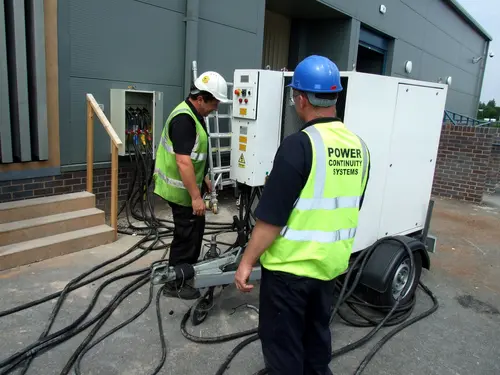
For optimum operating conditions follow this guidance:-
- The Generator has been and is regularly serviced.
- There is head room capacity on this set.
- Parts that require replacement have been replaced.
- Filters changed.
- Oil changed and topped up.
- Fuel has been polished every 12 months.
- Engine block heaters are turned ON and working.
- Coolant has been replaced and no leaks.
- Coolant is topped up.
- Batteries are fully charged with no leaks.
- All hoses are in good condition NO leaks.
- Breather caps are on and tight.
- Control panel display is working and visible.
- No loose electrical connections.
- Load at start up is no more than 65% of the generator capacity.
Generator terms explained:-
Emergency Standby generators allow a maximum of 10% overload available for 1 hour in any 12 Hour period. Prime Power: Is the maximum continuous power available for a varying electrical load for unlimited hours.
What are Step Loads?
Step loads are (not surprisingly) loads that happen in a single step.
How can it affect the generator sizing?
Every time you load up an engine, the speed (RPM) drops a bit (usually momentarily) before recovering. Generator engine manufacturers state the maximum FIRST load you can apply in one single “step” and thereafter WHAT additional step loads ensuring the engine doesn’t stall and fall over. Modern diesel engines need time to spool up the turbos, and brace themselves for the building load impact without over straining the engine. You can’t just slap 100% load on the engine and expect it to control the RPM without it falling over and stops. That’s important, for generator set sizing, because if your load is consists of a large single step hit at start-up, then you might need a much bigger generator than you thought.

What size Diesel Generator ?
Simply put you need to size the generator to ensure its sufficient to power your load, with head room. Hence, the first step is to determine all of the site loads, that require a diesel generator emergency backup. Bear in mind, that any generator can only accept approximately 65-70% of its maximum capacity at any one time. For a fact, always review any future growth to ensure that your generator will be big enough without the need for an additional larger generator. REMEMBER- take into account the power factor is 0.8.This applies to all diesel generators.
How to size a Diesel Generator Example
This example presents how to calculate the Diesel Generator Size. The rated power Pn (kVA) of a Generator is the maximum output power given an output power factor of 0.8. It is necessary to calculate the corresponding input power to determine the Diesel Generator power rating Therefore a Diesel GENERATOR of 100 kVA supplies the load with a maximum output power of 100 x 0.75 = 75 kW.
How to explain Diesel Generator Power Factor
Diesel Generators have a power factor of around 0.75-0.8. Gas Generators have a power factor of around 0.50. LPG Generators have a power factor of around 0.45.
Another helpful example
If the increase is 18% (value supplied by the manufacturer), the necessary input power is Pe = 80 x 1.18 = 94.4 kW. Therefore the Diesel Generator must be sized to supply power Pg. Such that, if the input power factor is 0.8, then Pg > 94.4 / 0.8 = 118 kVA. In this case, where both the input and output power factors are equal to 0.8, it is possible to calculate the result as 100kVA x 1.18 = 118 kVA.
If you’re looking for a Diesel Generator, call us on 0845 055 8455, we’re here to help!